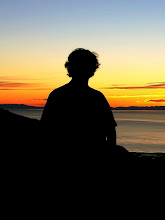
The next step was to define that which I sought. Upon some consideration, I redefined my question as “Do I have an identity that extends beyond context, i.e. my past and present experiences and actions?” The simplest experiment I could think of was to try and observe myself in a radically different context. From a reductionist standpoint, there are two significant weaknesses in the experiment’s design: a) as both observer and subject, I’d be prone to bias and, b) being privy to my observations, I’d invariably be affected by them, i.e. the act of observation would alter the subject of study. However, these could be offset to a degree by recognizing and accounting for them, as far as possible.
Monday, September 06, 2010
Half a world away, I journey inward

Wednesday, July 07, 2010
Wei Wu Wei - Action without action
‘Wu wei’, which roughly translates to ‘spontaneous/natural action’, is a Taoist concept applicable to the martial arts. The idea is for the martial artist to neither act nor remain passive, for these are both unilateral; both are states of inertia. He remains free from inertia in his interaction with the universe – which is represented by the opponent – and restores balance with minimal expenditure of energy. He forces neither action nor inaction, he neither attacks nor defends, he is neither protagonist nor antagonist. He rises above and beyond being a party to any conflict, and simply prevails through them. The opponent’s force which disturbs balance/oneness is countered with a smaller force that complements, rather than opposes it.
Friday, June 04, 2010
A Question of Balance
What follows is an attempt to crystallize some thoughts I’ve had with regard to my pursuit of gung fu. The words gung fu translate to ‘time and hard work’ and it is my understanding that the development of martial skill happens as much in the mind as in the body, if not more so. Developing skill demands not just constant training but constantly evolving training.
Wednesday, February 17, 2010
A walk in the rain
Weathered fingers clasped tightly around a flashlight, its faltering beam cutting a narrow swathe through inky blackness. Unrelenting rain drummed a hypnotic rhythm as it pattered on dense foliage, interrupted only by the squelch of wet grass under tired feet. The man kept a steady pace, a tattered poncho pulled tight over his head, following the narrow trail with practiced ease. He seemed in no particular hurry, however, even sodden as he was. Every few minutes, a frog croaked, seemingly always from a few paces off to his right. It seemed he only had the frog to share the night with, every other denizen of the jungle driven to its den by the rain. Rainwater streamed down his face in rivulets, blurring his vision, before disappearing into his long gray beard. But, the man neither stopped nor slowed. He walked, unwavering as the rain itself. Alone, within the immense darkness, he was more sharply conscious of his own existence than he had ever been. His reality was limited to the ground underfoot and the flashlight beam and the future extended no further than the next step. As thunderclaps counted off the passing hours, neither the rain stopped nor did he. It was a contest of will, a man against the elements themselves, and it concluded just as faint wisps of pre-dawn light crept up hesitantly onto the eastern skies. His pace steady, he walked on as night gave way to day and rain-clouds retreated, humbled and in defeat, to reveal clear blue skies. Coming up on a precipice, the man paused, gazing at the vast expanse of green that stretched out below. At the very edge, stood a figure, sodden and haggard, his shoulders slumped. As he turned around, the old man saw a bespectacled, curly haired youngster and figured he must have lost his way during the night. Just then, the sun peeked over the horizon, illuminating the faintest of smiles on both their faces. Feeling content, the man stirred. He had fallen asleep at his desk again. He smiled. He would write of a dream, of an old man, long since confined to a wheelchair, who dreamed every night of walking. In a log cabin across the jungle, another set of eyes fluttered open. The old man had fallen asleep in his wheelchair yet again.
Tuesday, February 16, 2010
Academia: Conflicting Perspectives
As a graduate student, I play the roles of both student and educator at different times. From time to time, I’m faced with a situation that elicits conflicting responses from these two parts of me. These are often issues pertaining to the responsibilities of students and educators towards each other and towards society at large. To further complicate my existence, there is my primary role as a researcher – about which I am the most passionate, by far. The researcher in me is ever eager to apply reductionist methodology to life, never willing to engage more than one problem at a time. This part of me is also eager to dismiss the aforementioned issues as being unrelated to the scientific question(s) at hand and therefore, inconsequential. However, these are issues are anything but inconsequential: issues that affect students and/or faculty at academic institutions have far-reaching effects on research conducted within the system of academia. So, the question boils down to, “Which voice do I listen to? Do I think of myself as a student, an educator or a researcher? Or perhaps, there is a way to reconcile these disparate voices?”
I’ve tried different approaches in the past. I’ve tried to be purely a student of my discipline, which happens to be science – a virtual non-member of the student body, completely oblivious to the mundane, everyday realities. In a sense, this is very much along the lines of being a scientist focused solely on research, unmindful even to the business of conducting that very research. At other times, I’ve tried to be a more active and vociferous member of the student body, whether by involving myself in student politics or by simply sticking to principles and vocal about my ideas and opinions as an individual. The consequences have ranged from minor victories to boredom and disgust over time/effort wasted over trivial details to being subject to the wrath of those in authority. The end result has been disillusionment which has left me with little faith in student political bodies. However, given the successes student movements have achieved in the past and my inability to conceive of viable alternatives, I have little choice but to function within the so-called “system” and seek change from within. While that would seem like a viable solution, it does not address what, for me, is the greater question: “How do I keep apathy at bay when it is so easy wrap myself in a warm blanket of scientific problems and ignore the world outside the lab?”
If and, hopefully, when I have an answer to that question, it will be the subject of a new post on this blog.
Monday, November 23, 2009
An evening at the movies
It’s dark. Long, languorous notes of “Shine on you crazy diamond” fill the room. I stir from my blissful state of inertia and take a look out the window. It’s cloudy and judging from the cool blow glow the mountains are bathed in, the sun must be pretty low in the sky. What time does that make it? Hmm, well what month of the year is this? November, yes, there’s a dusting of snow on the hillside. I suddenly feel the need for some crisp evening air and a movie. What’s playing? The Coen brothers have new movie out, “A Serious Man”. A comedy, perfect!
A change of attire, shoes, jacket and I’m sauntering down to the train stop, day-old snow crunching underfoot, Lisa Ekdahl singing to me. I look up and the moon is a crimson wisp in the western sky hanging over the brightly lit city with a quiet air of dignity. I wonder why I think the moon looks dignified. Grateful Dead’ “Friend of the devil” and few hundred more yards and I’m on the train. I peer out the window – the city looks sleepy. Maybe it’s me, maybe I’m sleepy. I see leafless trees reach up in to the sky like so many dried up, gnarly hands pleading for escape from the tired, gaudy neon lights, Jethro Tull’s “Bungle in the Jungle” plays in the background.
Head leaning against the window, I see the familiar geometric shapes of the city library come into view superimposed on a reflection of the railcar’s interior. It’s my stop, and it’s Calexico’s “Sunken Waltz”. A few dried yellow leaves peek through the snow, catching the multicolored lights of storefront signs, as I walk along familiar streets. Then I see the marquee, it’s the Broadway Cinema. Within seconds, I’m walking up to the concession stand, ticket in hand. The nice, familiar lady, whose name I don’t know, tells me of the movies she’s been watching lately as makes my usual cup of Earl Grey.
Tea in hand, I settle into my seat in the nearly empty cinema hall and pull out my headphones, all with a practiced ease that comes from repetition. Once again, it's practically a private screening. As I take a tentative first sip, the screen comes to life with the first of the trailers. I knew then, with absolute certainty, it was going to be another wonderful evening.
Saturday, September 26, 2009
Why I walk
Let me begin with a confession.
Four years ago, I was rather lost, unsure where my life was going. I knew on a deep level that I was passionate about science and that I should give research a serious try before making any decisions - but it was nothing more than a blind charge really. I felt like I'd not accomplished anything worthwhile and that in turn, led me to question who I was. I had a lot of questions and no way to really answer any of them. And, I constantly felt under pressure... to succeed, to live up to expectations. I've always been one to deal with my issues on my own - so, I pretended to be cocky, even arrogant, just to hide my fear and vulnerability. I knew even then that sooner or later facts would have to be faced, questions answered. I told myself that graduate school would be the time for that... I would use the opportunity and the freedom of being away from everyone and everything I knew to find myself.
The approach I came up with for this journey of self-discovery is one that I have previously described in some detail (see Empirical existentialism). I took up a back to basics approach:
- I would deconstruct myself down as close as possible to the very core of my being and then build myself back up.
- In order for my quest to be fruitful, I would have to pare myself down in both body and mind, eliminating as much of the undesirable and the non-essential as possible.
- Such a process is, by definition, infinite. More importantly, there would be a learning curve to even making a real start. I expected this to span between a few months and a few years. For this reason, I would not check my progress for at least the first year or two.
- Finding oneself entails locating and exceeding one's limits - mentally and physically. I find these to be best accomplished in solitude. I decided for that reason to skip explaining my actions to people. If bonds were strained, if bridges were burned... I would ascertain on a case-by-case basis what losses were acceptable.
- The implementation of this decision would require that I learn to dispassionately consider how people regarded me and my actions - in some cases people I had valued/continue to value significantly. And, often I would be required to not react to these opinions.
- Lastly, but perhaps most important of all, I could not permit myself any laxity in assessing myself. I would be my own harshest judge and critic.
On a physical level, I decided to go about achieving health and strength through effective management of food, sleep and exercise. I regularized my eating habits to eat three meals daily and the effect was a reduced but more consistent appetite than before. I also decided to indulge my liking for good food - particularly coffee, chocolate, vegetables and fruits while consciously avoiding soda and junk food. Pretty soon, I didn't crave the latter any more because I'd realized how bad they tasted - who'd want to drink a quart of coke when one can enjoy a nice single malt or a glass of fresh fruit juice? I took up kung fu, racquetball and hiking - activities I enjoy immensely which just happen to also provide exercise. Along the way, I had to deal with a pesky herniated disc in my lower spine... a painful experience both physically and financially but one I learned much from nonetheless. The resolution of that problem was neither instantaneous nor complete... to compensate for this, I began a daily stretching and calisthenics regimen. The net physical result is that I've gotten lighter (from 225 lbs to 166 lbs), faster, stronger and healthier... I finally feel like I'm getting into the physical condition necessary to live the life I want.
After much introspection and retrospection, I realized I needed to reevaluate the way I related to other people and to find avenues to channel my creative energies. With respect to the former, I set about playing reductionist, severing all non-essential and/or counter-beneficial ties from my past. Along the way, I started making new ties, picking up some very good friends in the process. As for the latter, I tried my hand at several hobbies including writing, sketching, hiking, photography, reef-keeping and kung fu. I gave up on sketching because it didn't feel like a natural way in which to express myself and I've indefinitely shelved reef-keeping purely because of financial and time constraints. Other than that, I've managed to stick with the other hobbies. In trying to keep up with the physical demands of kung fu, racquetball and hiking, I've had to push myself to the limits of my physical/mental endurance and beyond... and every step I've taken past what I thought were my limits has shown me something of myself I did not previously know existed. Passions of mine I'm glad to have indulged are reading, especially comic books and graphic novels, music and movies. The resulting changes are even more dramatic than my physical transformation - I've never been as happy, confident or at peace as I am now. I've also managed to largely rein in my previously wild temper. But most importantly, I've stopped feeling like an outsider all the time. While I may never be one to immerse myself in the thick of things as far as society is concerned, I've certainly grown more comfortable in this world of man that I inhabit. I've grown comfortable with the notion of being a member of the human species and that's saying a lot. All that being said, I've still got a ways to go... so, I'd better get on with it.